The Jamaica story
Out of many, one people. And every child is ours.
A story in seven chapters: how a young nation won its freedom, taught the world to listen and to run, and why the next chapter depends on our children.
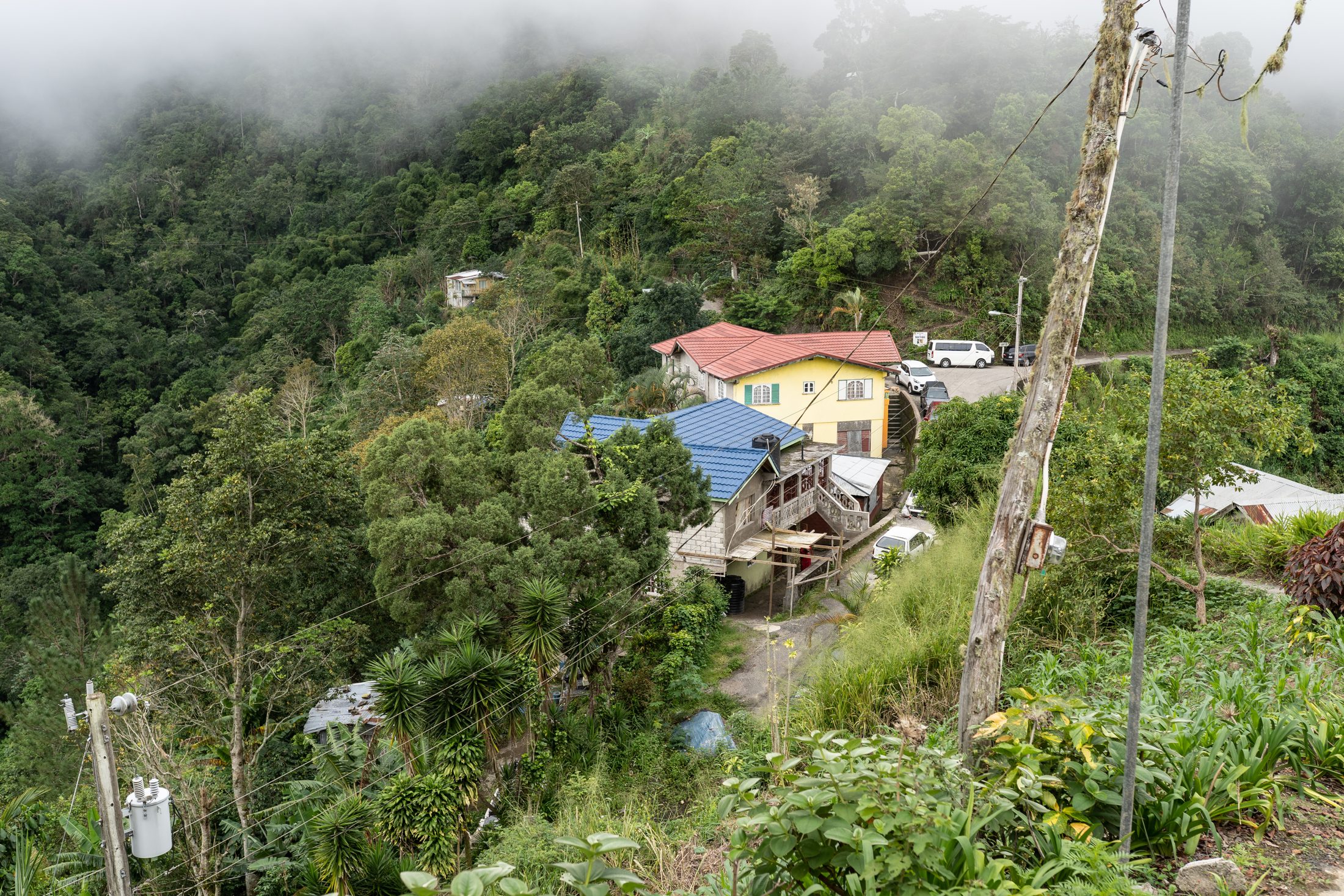
Begin the storyBlue Mountains, Portland Parish
06081962
It begins with a flag and a promise.
On 6 August 1962, Jamaica became an independent nation.1 A small island in the Caribbean Sea stepped onto the world stage under a bold motto: Out of Many, One People.1
Our parents and grandparents carried that promise everywhere they went: to Kingston and Montego Bay, and to London, Toronto, New York and Miami. Wherever Jamaicans have settled, the promise has gone with them.
A small island that taught the world to listen.
Few nations our size have left a mark this deep on the world's culture.
- 1963
A first Miss World crown
Jamaica's first Miss World title came just a year after Independence. Three more followed, in 1976, 1993 and 2019.2
- Our voice
Miss Lou gives our language its pride
Louise Bennett-Coverley, "Miss Lou", wrote and performed her poems in Jamaican Patois and worked to preserve our folk songs and stories in our own voice.3
- 1984
Bob Marley's Legend
Released three years after his death, Legend became the best-selling reggae album of all time and carried Jamaica's sound into homes all over the world.4
- Our hills
Blue Mountain coffee
Grown in the very mountains pictured above, Jamaica Blue Mountain coffee is a globally protected name, prized by coffee lovers everywhere.5
- 1988
A tropical island on ice
Jamaica's bobsleigh team made its debut at the Calgary Winter Olympics, the underdogs the whole world cheered for.6
- 1998
The Reggae Boyz go to France
Jamaica qualified for the FIFA World Cup and won its first match there, beating Japan 2–1.7
- 2018
Reggae, heritage of humanity
UNESCO inscribed the reggae music of Jamaica on its Representative List of the Intangible Cultural Heritage of Humanity.8
The fastest people on earth.
When a Jamaican steps onto the track, the world stops to watch. The tradition is older than the nation itself.
- 1948, London. Before Independence, Arthur Wint won Olympic 400 m gold just ahead of fellow Jamaican Herb McKenley.11 McKenley went on to win relay gold at Helsinki in 1952.12
- Merlene Ottey won nine Olympic medals and competed at a record seven Olympic Games, more than any other track and field athlete.13
- Veronica Campbell-Brown won Olympic 200 m gold in Athens 2004 and again in Beijing 2008.14
- Asafa Powell twice set the 100 m world record: 9.77 in 2005 and 9.74 in 2007.15
- Shelly-Ann Fraser-Pryce became the first Caribbean woman to win Olympic 100 m gold, in Beijing 2008, and defended her title in London 2012.10
- Elaine Thompson-Herah won the 100 m and 200 m at both Rio 2016 and Tokyo 2020, the first woman sprinter to win the double at consecutive Games.16
Talent has never been our problem. Opportunity is.
Famous, and sometimes infamous.
We love our country enough to tell the whole story. The world also knows Jamaica for headlines we are not proud of.
Debt and hard years
In the late 1970s and the 1980s, rising debt pushed Jamaica into repeated borrowing from the International Monetary Fund. Between 1977 and 1987 the country signed seven IMF agreements,17 and the austerity that came with them was felt in homes, hospitals and classrooms.18
A reputation for violence
For decades Jamaica has had one of the highest homicide rates in the world. Recent figures show real progress: in 2025 the island recorded fewer than 700 murders, the first time in more than 30 years.19 But the reputation lingers, and so does the hurt in the communities that carry it.
None of this is about blame. It is about who pays the price when times are hard. Too often, it is the children.
05 The turn
Independence can quietly become dependence.
Every August we celebrate 1962. But freedom isn't won once and kept forever. Each generation has to be equipped to carry it. If our children aren't fed, taught, healed and guided, independence slowly turns into dependence: on aid, on luck, on leaving.
Every year, visitors from all over the world fly into our island and call it paradise. They sip our coffee, dance to our music and watch the sun go down over our sea. We are glad they come.
But while others make Jamaica their paradise, some of Jamaica's own children are not equipped to succeed.
Not because they lack talent. You have seen what a Jamaican child can do with a fair start. They lack the basics: a full stomach, a pencil, a tutor, a mentor who keeps showing up, a dentist, a counsellor. The world runs at Jamaican speed. Our children should not be left standing at the start line.
We are the diaspora that sends barrels home at Christmas. We are the cousins and church sisters and old schoolmates. If we don't stand with these children, who will?
Empower the child. Elevate the nation.
United People of God exists to equip Jamaica's children and walk with them, so they grow into the people who will lift Jamaica higher. We already serve an average of 110 children every year. Here is how.
- 1
We go
Each year our team spends one month on the ground: teaching, mentoring, feeding, repairing, praying and playing alongside the children.
- 2
We stay
When the plane leaves, the care doesn't. Monthly giving keeps local tutors, meals and mentoring going all year round.
- 3
They rise
Children who are fed, taught, healed and guided can stay in school, dream bigger and give back to their communities and their country.
Everyday needs
Food, clothing, school supplies and feminine necessities, so no child misses school for want of the basics.
Learning & guidance
Mentorship, tutoring and homework help, so every child can read, count and believe in their future.
Health & wellbeing
Dental care, medical care and therapy, so children can heal, grow strong and carry less weight.
07 Your part
We cannot do this without your help!
Our athletes showed the world what Jamaicans can do with a fair start. Let's give every one of these children theirs. Give monthly from $10, or come and serve with us on the ground.
Giving $10 or more each month unlocks the members gallery: see what your money does, up close.
“So that Jamaica may, under God, increase in beauty, fellowship, and prosperity.”From the National Pledge of Jamaica22
Sources
- Jamaica: independence on 6 August 1962 and the national motto. Wikipedia, "Jamaica"
- Jamaica's Miss World titles (1963, 1976, 1993, 2019). Wikipedia, "List of Miss World titleholders"
- Wikipedia, "Louise Bennett-Coverley"
- Legend (1984), best-selling reggae album. Wikipedia, "Bob Marley"
- Wikipedia, "Jamaican Blue Mountain Coffee"
- Wikipedia, "Jamaica national bobsleigh team"
- Wikipedia, "Jamaica national football team"
- UNESCO, "Reggae music of Jamaica", inscribed 2018
- Wikipedia, "Usain Bolt"
- Wikipedia, "Shelly-Ann Fraser-Pryce"
- Wikipedia, "Jamaica at the 1948 Summer Olympics"
- Wikipedia, "Herb McKenley"
- Wikipedia, "Merlene Ottey"
- Wikipedia, "Veronica Campbell Brown"
- Wikipedia, "Asafa Powell"
- Wikipedia, "Elaine Thompson-Herah"
- Sandra Henry, "Conditionalities and Cross-conditionalities in the 1980s: The Jamaican Experience". Springer (abstract)
- IMF financing tied to austerity measures in the 1980s. Wikipedia, "Economy of Jamaica"
- Wikipedia, "Crime in Jamaica"
- UNICEF Jamaica, "MICS data show that Jamaica needs to accelerate steps towards achieving SDG targets for children" (Multiple Indicator Cluster Survey 2022). unicef.org
- UNICEF Jamaica, "Ja Must Invest More in Violence Prevention and Response Efforts" (Violence Against Children and Youth Survey 2023), 14 November 2024. unicef.org
- National Pledge of Jamaica. National Library of Jamaica
Photo: Blue Mountains, Portland Parish (see README for image credits). Athlete achievements are shown as typography rather than photographs.